
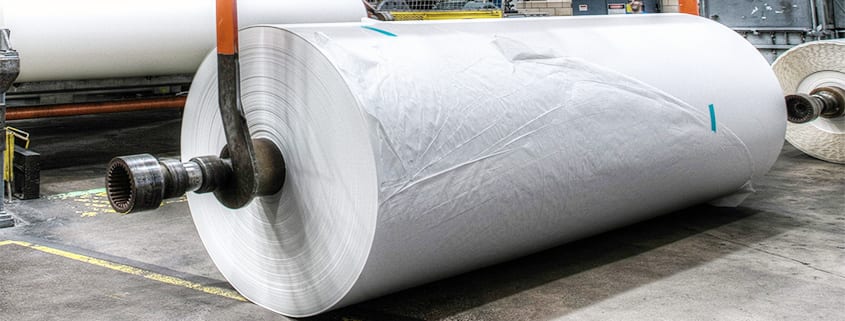
Glassine is a unique type of paper that has been mistaken for other substrates, such as wax paper, parchment, and even plastic. Because of its distinctive look and feel, it may not seem like regular paper. And it’s not! Let’s take a closer look at glassine’s manufacturing process to see how each step contributes to the final product.
What is Glassine?
Glassine is a smooth, translucent paper with a glossy sheen. As a result of its manufacturing process, glassine is pH neutral and acid free, and it’s resistant to moisture, air, and grease. Glassine packaging offers a high-end feel, plus its semi-transparent quality allows what’s inside the paper to show through. Because it is made from wood pulp, glassine is fully recyclable and biodegradable, making it a sustainable material choice.
How glassine is made
Glassine is made from hardwood trees, primarily varieties of aspen, oak, birch, and gum. Once the trees are grown to a specific size, the virgin timber is felled, stripped of its branches and twigs, and cut for transport. When logs arrive at the paper mill, they are completely debarked and sent to chippers, where they are cut into pieces for mechanical or chemical pulping.
The first step in the papermaking process is converting the trees into pulp (the fibrous raw material used to make paper). The pulping process cooks the wood chips under pressure in a variety of ion solutions to break the chemical bond of the lignin (the organic polymers that form the cell walls and support tissue in plants). This process separates the pure cellulose fibers from the lignin and other substances.
Removing all of the lignin from the fiber during the pulping process is a crucial step in making glassine paper. If lignin remains in the pulp during bleaching, the chemical reaction with the bleach turns the lignin into hydrochloric acid, which can make the paper brittle and discolored over time. By removing the lignin, the pulp produces a paper with a neutral pH level and higher resistance to changes in chemical, structural, or optical properties. These properties are what make glassine so unique.
The wood fibers that remain are bleached and treated further with dyes, pigments, or additives to fit the desired grade and color before moving on to the paper machine. There, the watery pulp slurry flows onto a moving wire cloth where most of the water drains away. The fibers mat and intertwine as paper sheets begin to take form. More of the water is squeezed from the damp mat as it passes through a series of roller presses and finally through a dryer.
Glassine supercalendering
Calendering is the final step in the papermaking process. This smooths the surface of the paper by pressing it between hard pressure cylinders or rollers — called calendars.
Glassine gets its uniquely smooth, transparent, and glossy properties through a process called supercalendering. This process is completed by putting the paper through the calendaring process multiple times or, more often, by performing the pressing on a special machine with heated or cooled pressurized calendars.
Supercalendering machines are specifically designed to apply pressure, heat, and friction at high speeds through vertical, alternating stacks of hard polished steel rollers paired with softer fiber-covered cylinders (called nips). As the high-speed calenders spin, the soft rolls struggle to return to their original dimensions and buff the paper passing through the nips. The force generated by each progressive nip polishes both surfaces of the paper.
At a cellular level, the supercalendering process breaks down the capillaries of the paper fibers. This gives the paper a highly closed surface with improved density and very low porosity. As a result, supercalendaring makes glassine resistant to grease, air, and moisture – ideal barrier protection from many substances.
Other types of paper contain wax coatings or plastic laminates to achieve these protective benefits. However, plastic fragments and silicone coatings are typically less biodegradable. Free from waxes or coatings, glassine is a sustainable alternative to laminated counterparts.
Once the glassine paper completes its journey through the supercalendering machine, it is rolled or sheeted. Glassine sheets are often used for interleaving, inserting specific-sized sheets between delicate artwork, documents, books, or photos to protect from damage. Sheets are also used for windowing of envelopes and manufacturing fully translucent envelopes.
How glassine gets its unique appearance
Glassine is used most often in its translucent form because it shows what is beneath the paper. The color can be changed during the pulping process with the addition of dyes. Other additives, such as clay, titanium dioxide, or calcium carbonate, reduce the amount of light that is transmitted through the paper—making glassine more opaque.
The degree and quality of the supercalendering machine impacts how dense, and in turn how translucent, the final product becomes. Quality can vary drastically among manufacturers, with cheaper glassine paper usually losing clarity.
Adjustments in the supercalendering process determine the weight, caliper (thickness), clarity, brightness, smoothness, strength, and grade of the final product.
- Glassine’s significantly higher density and caliper give it greater bursting and tensile strength, folding endurance, and stiffness than papers of similar weight. Glassine is generally available in densities between 40–90 grams per square meter (gsm)—more than twice as dense as other common papers.
- Glassine is manufactured within a narrow caliper tolerance, meaning measurements of the thickness are highly accurate to within 0.01 millimeters.
- Paper typically absorbs water vapor from the surrounding atmosphere (hygroscopicity), which causes it to expand or contract with the relative humidity (hygroexpansivity). However, the breakdown of cellulose during the manufacturing process of glassine makes it less susceptible to atmospheric changes.
- High-quality glassine is hard-wearing, making it a robust choice for enclosures and packaging.
Converting glassine, from printing to finishing
Glassine’s surface is suitable for rotogravure, offset, flexo, and digital printing. Supercalendaring renders glassine paper less porous, which means lower levels of ink absorption, making it more difficult to print. Because inks take longer to dry, smearing during or after printing is a concern. Printing on glassine requires both expertise and experience with printing processes and a variety of inks, especially to achieve fine-line images in vivid, full color.
Glassine can be embossed and debossed to create impactful three-dimensional effects. But because of its body and smooth surface, glassine paper tends to shift and crinkle, making embossing difficult. Finishing glassine requires expertise in machine modifications and strategically adjusting guides and tensions.
How glassine is different from related products
Very few materials offer the widespread benefits of glassine in a single substrate. While glassine has been confused with other substrates, such as wax paper and parchment, it really is one of a kind. It protects against grease, water, air, and moisture. It’s approved for direct food contact. It can be safely sterilized. What’s more, glassine can help lower your environmental impact. Free from coatings or dyes, glassine is fully recyclable and biodegradable.
See how other products compare to glassine:
- Vellum dates back hundreds of years. The term initially referred to a paper-like material made from calfskin by stretching, drying, tanning and refining it until it became very thin and slightly translucent. Today, vellum is the term used for a type of finish or surface structure for uncoated commercial printing papers. It is commonly used to describe all translucent papers. Along with its translucent quality, true vellum paper has a distinctive toothy or slightly rough surface, which contrasts with glassine’s smooth feel. And unlike glassine’s relative strength and durability, vellum is considerably more delicate and can be easily punctured or torn.
- Parchment paper is a cellulose-based paper that has been chemically treated and infused with silicone to create a non-stick surface. This surface is both water- and heat-resistant up to 420°-450°F. Because of its coating, parchment paper is reusable but not recyclable or compostable. And unlike glassine, parchment paper is difficult to print on or adhere labeling to.
- Wax paper is coated with a thin layer of paraffin or soybean-based wax. The coating makes it nonstick and water-resistant, but not heat-resistant. Wax paper is often used for the presentation and storage of food. It is not safe to use in ovens because it can smoke, melt or even ignite. In addition, the wax coating applied to the paper takes much longer to biodegrade than the paper itself. As a result, wax paper is not considered recyclable or compostable. Glassine is an excellent compostable wax paper alternative! Wax paper is also difficult to print on or adhere to.
- Cellophane is a completely transparent film that looks like plastic—but it’s actually cellulose that has been removed from wood, hemp, cotton, or another plant source. Cellophane is resistant to oil, grease and water vapor, but is so thin that it is vulnerable to liquids. Cellophane’s manufacturing process is not eco-friendly because it uses toxic chemicals (such as carbon disulfide) to remove elements and soften and bleach the cellulose. These chemicals could release methane if lodged in a landfill.
JBM is leading glassine packaging innovations like glassine envelopes, bags, and sheets
At JBM, glassine is a specialty and a strength. For decades, JBM has manufactured billions of glassine sheets, glassine bags and glassine envelopes, investing years of research into creating the ideal glassine packaging solutions. Furthermore, the JBM Innovation Team has tested multiple inks and printing processes to optimize the sometimes-tricky process of printing on glassine paper. From stamp collecting and sterilized surgical needles to chocolate wrappers and soaps, customers have successfully used JBM’s custom-printed glassine envelopes, pouches and bags across industries in numerous applications. Samples of beautiful glassine packaging from JBM are available upon request.